

Creative feedback is the structured exchange of suggestions and insights on creative work to refine it for better quality and effectiveness.
Giving effective feedback on creatives requires a structured approach that evaluates work at different levels of the creative process. Reviewers need to understand the creator’s intent, evaluate the creative based on defined goals, describe issues and suggestions clearly and specifically, separate problems from solutions, and use structured tools and processes to improve the outcome.
Instead of reacting instinctively to critiques, effective reviewers explain their observations, apply emotional intelligence while communicating feedback, and focus on the design rather than the designer.
This approach transforms feedback from a subjective critique into a collaborative process that helps creators improve their work with clarity and confidence.
What is creative feedback?
Creative feedback is the structured process used to evaluate creative work, including designs, visuals, or prototypes, against defined objectives and performance criteria.
Effective creative feedback is specific, contextual, and outcome-driven. It involves sharing observations, suggestions, or constructive insights from stakeholders to help designers understand what works, what does not, and why, including the improvements that can be made.
Rather than relying on personal opinion, preference, or taste, creative feedback establishes shared evaluation criteria that allow both reviewers (feedback providers) and creators (feedback receivers) to engage without defensiveness or subjectivity. It ensures creative aligns with the audience’s needs, brand standards, and business goals to improve overall effectiveness.
Creative feedback occurs at multiple stages of the creative development process, with focus varying by level and asset purpose.
- Strategic level: Alignment with business objectives and audience positioning
- Conceptual level: Strength of idea, narrative, and differentiation
- Execution level: Clarity, design consistency, accessibility, and usability
- Performance level: Conversion strength, engagement signals, and behavioral impact
Why is it important to give creative feedback effectively?
Creative feedback ensures alignment, minimizes revision cycles, strengthens collaboration, eliminates ambiguity and gaps, saves resources, and improves execution quality.
- Ensures output alignment: Creative feedback that observations and instructions remain clearly aligned with the project objectives, and not influenced by personal preferences or opinion-driven judgments. It established a shared reference for evaluating work, preventing confusion, and making decisions.
- Reduces revision cycles: Creative feedback that is specific, aligned, and delivered at various stages of the creative process helps teams identify issues early and implement changes accurately. This ensures work moves forward steadily without unnecessary revision loops.
- Supports collaboration and accountability: Creative feedback involves a collaborative exchange between designers and reviewers. When feedback is documented and explained clearly, contributors remain accountable for their suggestions, responsibilities, and decisions.
- Eliminates ambiguity: Structured feedback allows reviewers to communicate constraints, expectations, and improvement areas. When it is documented in specific and understandable terms, creators can interpret suggestions accurately.
- Saves time and resources: Effective creative feedback introduces a systematic way to evaluate creative work, reducing unnecessary back-and-forth and revisions that drain time and energy. Teams can focus on these meaningful, high-impact changes to launch campaigns faster.
- Improves quality and precision: Thoughtful feedback helps creators to refine ideas, challenge assumptions, and sharpen execution. The practice encourages creators to produce more polished and effective creative assets that elevate the quality of their work.
How to give better creative feedback?
Giving better creative feedback requires a structured evaluation process, which involves understanding the creator’s intent, aligning with project objectives, describing observable issues, consolidating feedback, and providing actionable suggestions that improve the creative outcome.
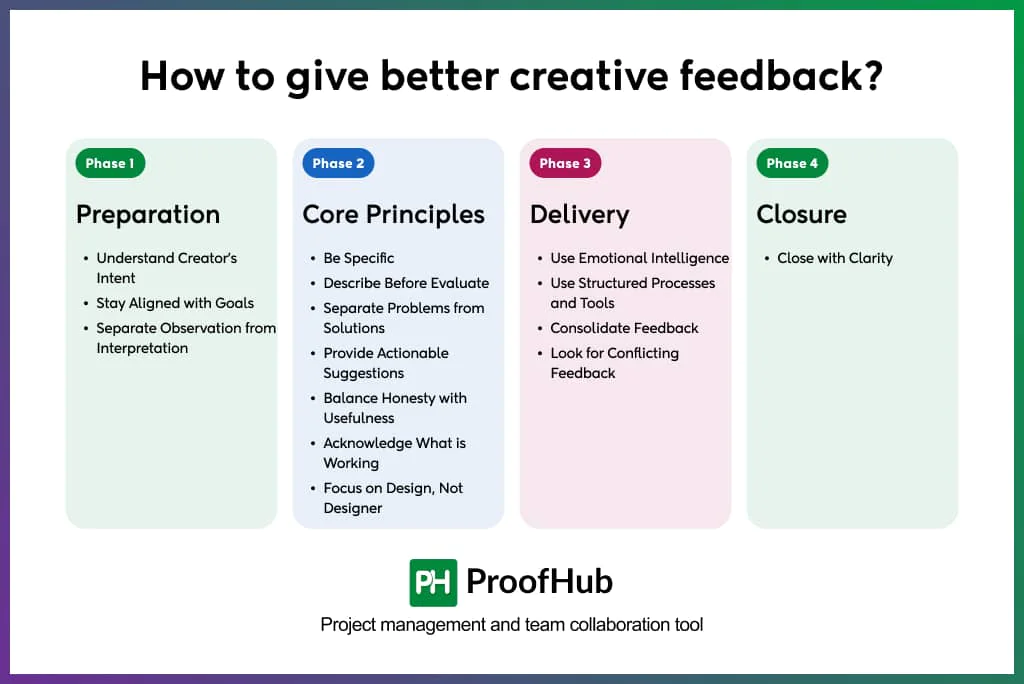
Phase 1: Preparation (Before feedback)
1. Understand the creator’s intent
Effective creative feedback begins by understanding why creative decisions were made. When reviewers first understand the creator’s intent, they avoid criticizing choices that were deliberately made to enhance user experience or support the strategy.
This intentional practice encourages reviewers to look beyond their personal preferences and provide balanced and constructive feedback.
Instead of saying: “Why is the layout so minimal?”
Ask: “Was the minimal layout intended to create a premium feel or reduce visual distraction?”
2. Stay aligned with defined goals
Effective creative feedback evaluates whether the work aligns with the defined project objectives.
Every suggestion should consider the campaign goal, user outcome, or communication objective before recommending changes. The practice ensures discussions remain focused on improving effectiveness rather than drifting toward subjective preferences.
If the campaign goal is to increase sign-ups:
Less helpful feedback: “The headline feels boring.”
Goal-aligned feedback: “If the goal is to increase sign-ups, the headline may need a clearer benefit statement to motivate action.”
3. Separate observation from interpretation
Observation and interpretation are two different components of feedback. Where the former describes what is visible in the creative, interpretation explains the potential effect on users or outcomes.
When they are combined in one statement, feedback becomes vague and difficult to act upon.
Separating the two helps creators understand both the issue and the reasoning behind it. Because if either the observation or the interpretation is wrong, it can be discussed and addressed independently.
Mixed statement: “The page is confusing.”
Separated feedback:
Observation: “There are three different calls to action on the page.”
Interpretation: “Because there are multiple CTAs, users may struggle to decide what to do first.”
Phase 2: Core Principles (What makes feedback effective)
4. Be specific
Specific feedback provides clarity and prevents unnecessary revision cycles.
When reviewers provide exact issues in the creatives, creators save time on guesswork, work confidently on improvements, and provide revisions that closely match the reviewer’s expectations.
Vague feedback: “The layout feels off.”
Specific feedback: “The headline and image compete for attention because they are similar in size and placement.”
5. Describe before you evaluate
Effective critique provides a neutral description of the creative before moving to judgment. This approach helps provide context and ensures everyone understands the work in the same way.
Once everyone is aligned, evaluation becomes more objective, logical, and constructive. The approach lowers the chances of premature rejection and helps creators understand the criteria against which the work is being evaluated.
Description: “The illustration uses muted colors and large white space.”
Evaluation: “If the campaign aims to feel energetic, the muted palette may reduce that impact.”
6. Separate problems from solutions
Effective feedback identifies the problem before recommending solutions. Jumping directly to solutions limits exploration and prevents creators from proposing their suggestions.
When reviewers describe the issue first, creators gain an opportunity to analyze the problem and explore multiple solutions to address it. And these may turn out to be the better fixes compared to the first solution.
Better feedback: “The headline doesn’t stand out enough compared to the surrounding elements, so it’s difficult to identify the main message. You may increase contrast, adjust hierarchy, or reposition the headline.”
7. Provide actionable suggestions
Actionable feedback converts insights into progress.
When insights are paired with practical improvements or possible actions, creators gain clarity about the direction to work in while still maintaining their creative flexibility to choose the best implementation approach.
Problem: “The call-to-action blends into the background.”
Actionable suggestion: “Increasing contrast or using a more prominent color could make the button easier to notice.”
8. Balance honesty with usefulness
Creative feedback requires honest but constructive and solution-focused evaluation. Direct criticism without context discourages collaboration and creativity, while overly polite feedback hides important issues and wastes time.
Balanced feedback communicates the problem clearly while highlighting its impact. This approach helps creators understand the concerns without feeling discouraged.
Unhelpful honesty: “This layout is confusing.”
Constructive honesty: “The layout looks visually strong, but the navigation and call-to-action appear in similar visual weight, which makes it difficult to know where to focus first.”
9. Acknowledge what is working
Feedback that acknowledges what works well, alongside areas for improvement, makes creators more confident and adaptable to recommendations. They understand what should remain unchanged and what needs adjustment.
Acknowledging strong elements maintains morale and keeps creative energy high during revision cycles. This also prevents creators from making any unnecessary or accidental changes.
Example: “The typography pairing works well and reinforces the brand’s professional tone perfectly.”
10. Focus on the design, not the designer
Effective feedback evaluates the work rather than criticizing the person who created it. When feedback becomes personal, creators are more likely to feel attacked and become defensive to accepting the suggestions.
Work-focused feedback keeps discussions professional by shifting focus from assigning blame to encouraging problem-solving and improving outcomes.
Personal criticism: “You didn’t structure this well.”
Work-focused feedback: “The hierarchy makes it difficult to scan the content.”
Phase 3: Delivery (How to communicate feedback)
11. Use emotional intelligence
Emotionally aware creative feedback recognizes that how feedback is delivered matters as much as what is being said. Taking into account the creator’s effort, context, and perspective while sharing feedback often determines how well it lands and influences improvement.
Feedback timing, tone, and the recipient’s emotional state greatly influence how your feedback is perceived and acted upon. It decides whether the feedback is accepted with openness or defensiveness.
Instead of starting with criticism: “What part of this concept are you most confident about?”
12. Use structured processes and tools
Structured review processes and feedback systems provide a clear framework that makes feedback easier to give, track, and follow. When feedback is documented directly on creatives inside review tools like ProofHub, discussions remain organized, and decisions become easier to follow.
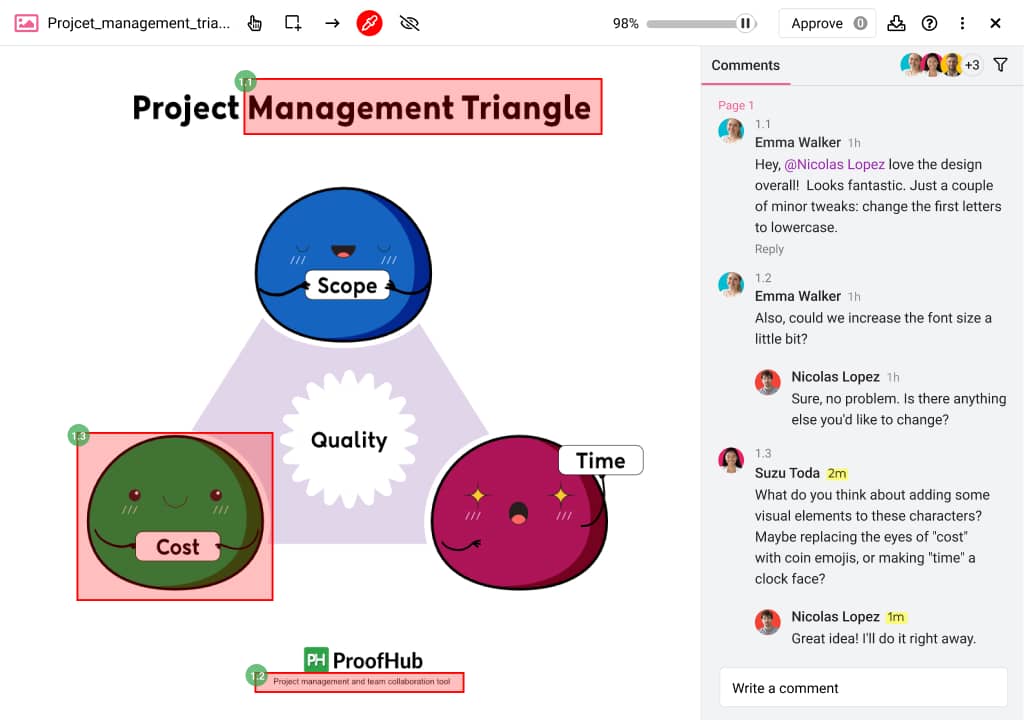
Centralized review tools reduce ambiguity and ensure accountability, making it easier for teams to trace decisions, identify who made revisions, and confirm whether feedback has been addressed.
Examples include:
- Structured critique sessions
- Commenting systems in design tools
- Annotated review
Common tools used in creative collaboration include: ProofHub, Figma, and Filestage.
13. Consolidate your feedback
Consolidating feedback helps creators avoid the overwhelm that comes from locating inputs in different places.
Having an organized summary of feedback and observations helps creators understand the most important issues effectively and implement high-impact revisions in the first attempt.
Example: Rather than leaving twenty scattered comments,
- Summarize feedback in one place
- Group-related issues
- Remove duplicate comments
14. Look for conflicting feedback
In collaborative environments where multiple reviewers evaluate creative work, they suggest changes from different perspectives that often contradict. This makes creators uncertain about which direction to follow, forcing them to choose between incompatible suggestions and attempt to satisfy multiple directions simultaneously.
Identifying these contradictions early allows teams to align on priorities, follow consistent direction, and prevent unnecessary rework and revisions that cannot coexist.
Example: “One suggestion recommends simplifying the layout, while another suggests adding more content. We may need to prioritize either clarity or detail.”
Phase 4: Closure (Ending the feedback session)
15. Close with clarity
Give formal closure to the creative feedback by confirming a shared understanding of the next steps between reviewers and creators. This helps surface misalignments and unresolved questions early in the process, allowing teams to summarize agreed revision priorities and establish a clear path forward.
When closure is done well, everyone walks away knowing exactly what to change and what matters most in the next iteration.
Example: “To summarize, the next iteration should focus on strengthening the headline, simplifying the layout hierarchy, and improving the CTA visibility.”
Or you can ensure alignment by confirming the understanding with the recipient:
“Does this align with your understanding of the next steps?”
Examples of effective creative feedback
Here are two examples of effective creative feedback:
1. Ineffective: “I don’t like this design.”
Effective: “The hierarchy isn’t clear—my eye goes to the testimonial quote first instead of the headline. Try increasing the headline size by 30% and reducing the testimonial to secondary weight so users immediately understand the main message. Also, the color contrast reduces readability. Increase contrast ratio for accessibility compliance.”
Why it works: Identifies the specific problem and suggests an actionable direction.
2. Ineffective: “This layout is confusing.”
Effective: “Users will likely miss the ‘Add to Cart’ button because it’s below the fold on mobile and uses the same blue as all the other secondary links. Try making it a high-contrast color (like our brand orange) and fixing it to the bottom of the screen so it’s always visible while they scroll through product details.”
Why it works: Explains the problem users may face, identifies the causes, and suggests device-specific solutions.
What types of creative assets require feedback?
All the brand expression, marketing, communication, product, sales, and editorial assets require feedback aligned with the defined purpose and established standards.
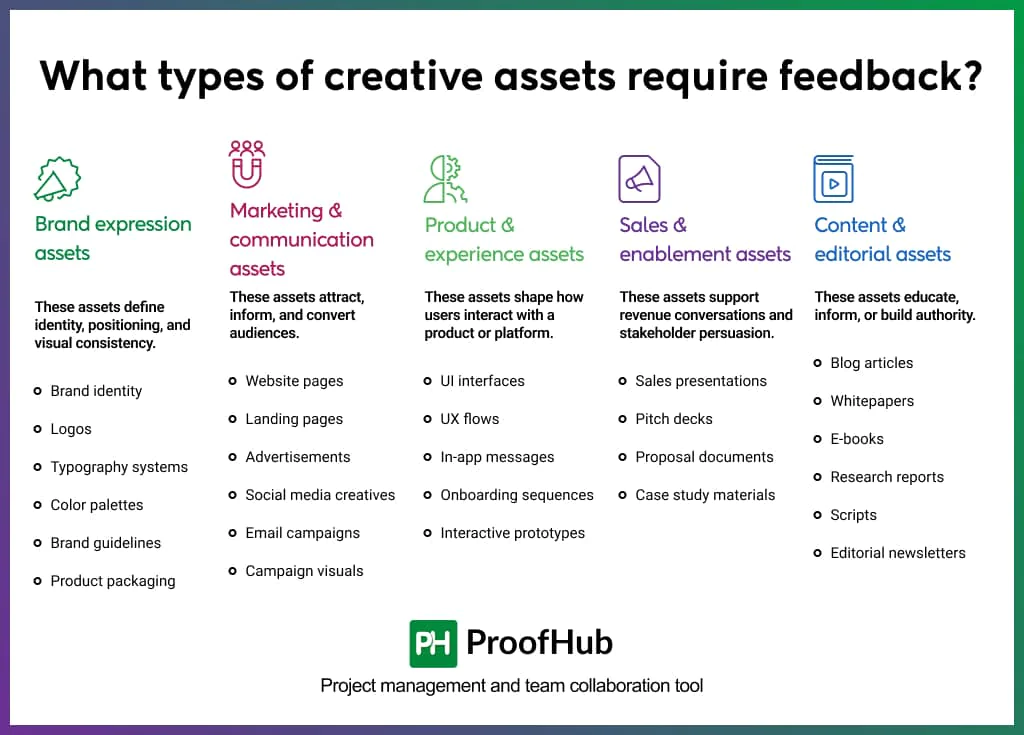
1. Brand expression assets
These assets define identity, positioning, and visual consistency.
- Brand identity systems
- Logos
- Typography systems
- Color palettes
- Brand guidelines
- Product packaging
2. Marketing & communication assets
These assets attract, inform, and convert audiences.
- Website pages
- Landing pages
- Advertisements
- Social media creatives
- Email campaigns
- Campaign visuals
3. Product & experience assets
These assets shape how users interact with a product or platform.
- UI interfaces
- UX flows
- In-app messages
- Onboarding sequences
- Interactive prototypes
4. Sales & enablement assets
These assets support revenue conversations and stakeholder persuasion.
- Sales presentations
- Pitch decks
- Proposal documents
- Case study materials
5. Content & editorial assets
These assets educate, inform, or build authority.
- Blog articles
- Whitepapers
- E-books
- Research reports
- Scripts
- Editorial newsletters
How to ask for helpful feedback on creative work?
Helpful feedback on creative work can be requested by defining the review stage, specifying feedback objectives, providing relevant context, involving relevant reviewers, clarifying feedback during discussion, and confirming shared understanding before revision.
1. Define the stage: The creator defines the development stage of the creative to reviewers before requesting feedback to ensure correct evaluation. This prevents reviewers from suggesting premature redesign suggestions.
Different stages require different feedback focus:
- Concept validation
- Work-in-progress review
- Execution refinement
- Pre-launch approval
Example:
“Work-in-progress review: Feedback needed on layout hierarchy, not final visuals or colors.”
2. Specify the feedback objectives: The creator defines exactly what aspect of the creative requires evaluation instead of general opinion. These insights help reviewers evaluate specific elements and provide focused suggestions.
Example:
“Please review whether the headline clearly communicates value to first-time users and whether the CTA stands out on mobile screens.”
3. Provide necessary context: The creator provides relevant information to reviewers to ensure correctness against the intended goals.
Context typically includes:
- Campaign objective
- Target audience
- Platform environment
- Success metric
- Creative constraints
Example:
“This landing page targets first-time visitors arriving from paid ads. The goal is to improve sign-ups, so feedback should focus on message clarity and conversion flow.”
4. Involve the relevant reviewer: The creator requests feedback from stakeholders whose expertise greatly improves relevance and output alignment with shared objectives.
Example:
“Requesting UX review for navigation clarity and marketing review for message positioning.”
5. Ask clarifying questions: The creator clarifies reviewer observations during discussion to eliminate interpretation gaps and understand the right direction before revision begins.
Example:
“You mentioned the message feels unclear. Is the issue in the headline or supporting copy?”
6. Confirm shared understanding: The creator summarizes feedback and confirms agreement on required changes before implementation. The confirmation ensures everyone is on the same page and reduces the probability of repeated correction cycles.
Example:
“To confirm – improving CTA visibility on mobile screens is the required update before approval?”
What are the 5Rs of effective feedback?
The 5Rs of effective feedback include Request (taking initiative), Receive (accepting feedback), Reflect (deriving insights), Respond (refining understanding and answering thoughtfully), and Resolve (implementing changes).
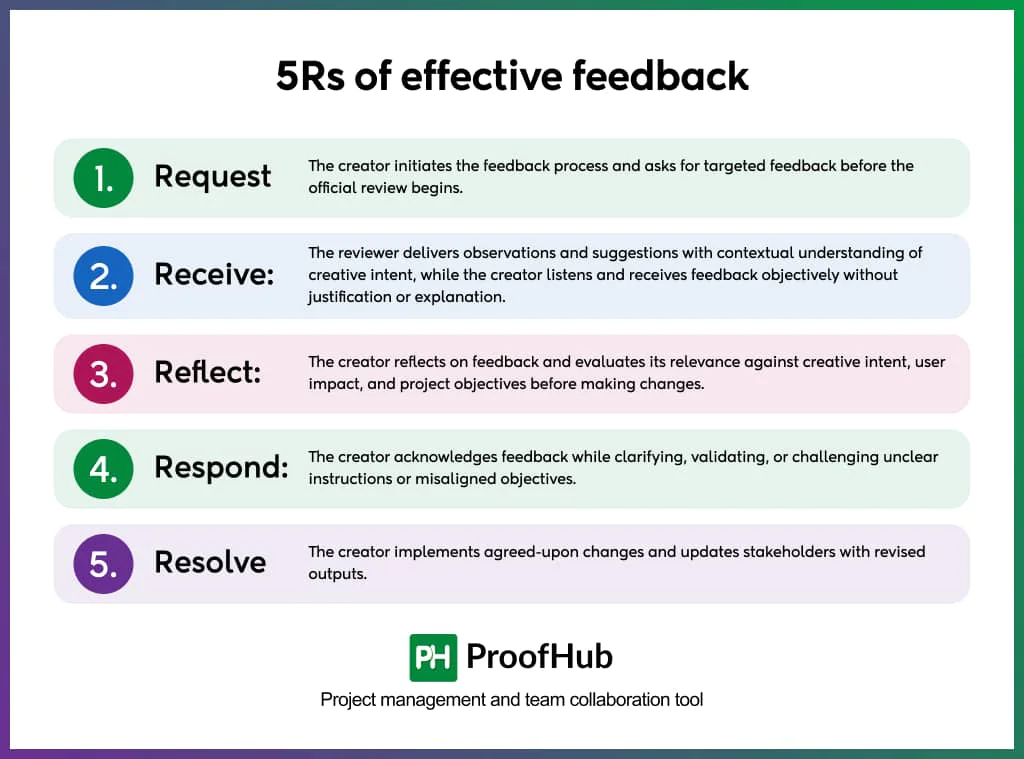
1. Request: The creator initiates the feedback process and asks for targeted feedback before the official review begins.
The request specifies the objective, audience context, and evaluation boundaries and scope to which the reviewer responds with focused, actionable feedback, while ensuring creative evaluation remains targeted and aligns with creative intent.
Example:
Instead of saying: “Please share feedback.”
The creator requests:
“Please review whether the headline communicates value clearly to first-time users and whether the CTA stands out on mobile.”
2. Receive: The reviewer delivers observations and suggestions with contextual understanding of creative intent, while the creator listens and receives feedback objectively without justification or explanation.
Instead of reacting prematurely, the creator records feedback, seeks clarification where required, and confirms understanding before responding or revising.
Example:
Instead of responding instantly: “That design choice was intentional.”
The creator receives feedback by confirming:
“You’re saying the CTA feels difficult to notice on mobile screens?”
3. Reflect: The creator reflects on feedback and evaluates its relevance against creative intent, user impact, and project objectives before making changes.
Effective reflection helps creators determine what feedback supports intended outcomes, improves comprehension, and guides informed decision-making forward, avoiding conflicting revisions and endless iteration loops.
Example:
The reviewer says: “The design feels too minimal.”
Reflection converts this into evaluation:
- Is the information unclear to users?
- Is hierarchy weak?
- Or is this stylistic preference?
4. Respond: The creator acknowledges feedback while clarifying, validating, or challenging unclear instructions or misaligned objectives.
Structured clarification eliminates ambiguity, reduces incorrect revisions, and establishes shared understanding before execution begins.
Instead of silently revising after feedback:
Reviewer: “The design feels crowded.”
The creator responds:
“Are you referring to visual hierarchy or content density on mobile screens?”
5. Resolve: The creator implements agreed-upon changes and updates stakeholders with revised outputs.
The reviewer verifies that the finalized creative output aligns with the feedback objectives defined during the review process. After confirmation, the creator formally closes feedback items to prevent recurring revisions and ensure approval readiness.
Instead of:
“Changes have been made.”
Resolution communicates:
“CTA visibility improved for mobile screens as requested. Please confirm alignment with conversion objective.”
How does creative feedback reduce revision cycles?
Creative feedback reduces revision cycles by aligning evaluation criteria, removing interpretation gaps, and ensuring decisions are validated before creative revisions begin.
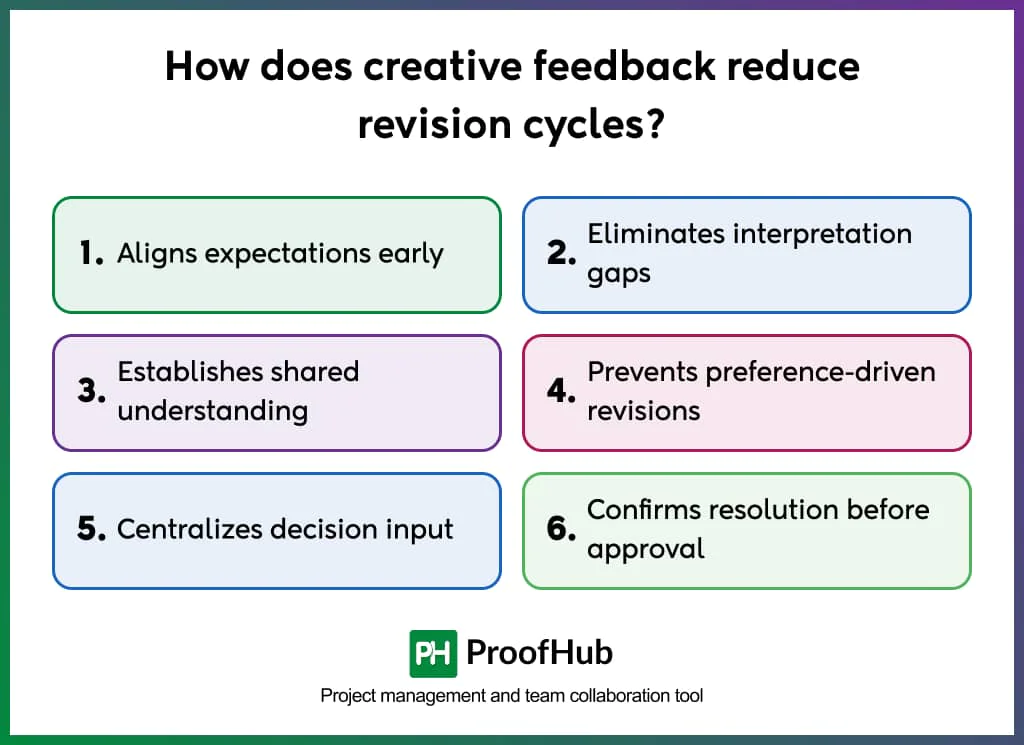
- Aligns expectations early: Creative feedback aligns reviewers and designers across the creative’s objective, audience intent, brand guidelines, usability, and performance goals before the revision starts, reducing corrective work later.
- Eliminates interpretation gaps: Creative feedback enables reviewers to specify the exact issue, while receivers clarify intent, constraints, or assumptions. This shared clarity prevents rework caused by misunderstandings.
- Establishes shared understanding: Creators and reviewers collectively discuss, evaluate, and confirm meaning before implementation. This agreement helps validate concerns and minimize back-and-forth iterations.
- Prevents preference-driven revisions: Creators ensure their reviews remain consistent and aligned with defined objectives and evaluation criteria, reducing subjective opinions, preferences, or personal taste.
- Centralizes decision input: Structured feedback consolidates stakeholder input into defined review stages instead of scattered emails, chats, or stakeholders. The centralization prevents conflicting instructions and extra revision rounds.
- Confirms resolution before approval: Implemented changes are verified with reviewers against established objectives before closing the feedback loop, ensuring resolved issues do not surface later.
What frameworks work best for delivering creative feedback?
Some frameworks that work best for delivering creative feedback are SBI, The IDEA, AID, I like/I wish/ I wonder, The feedback sandwich, etc.
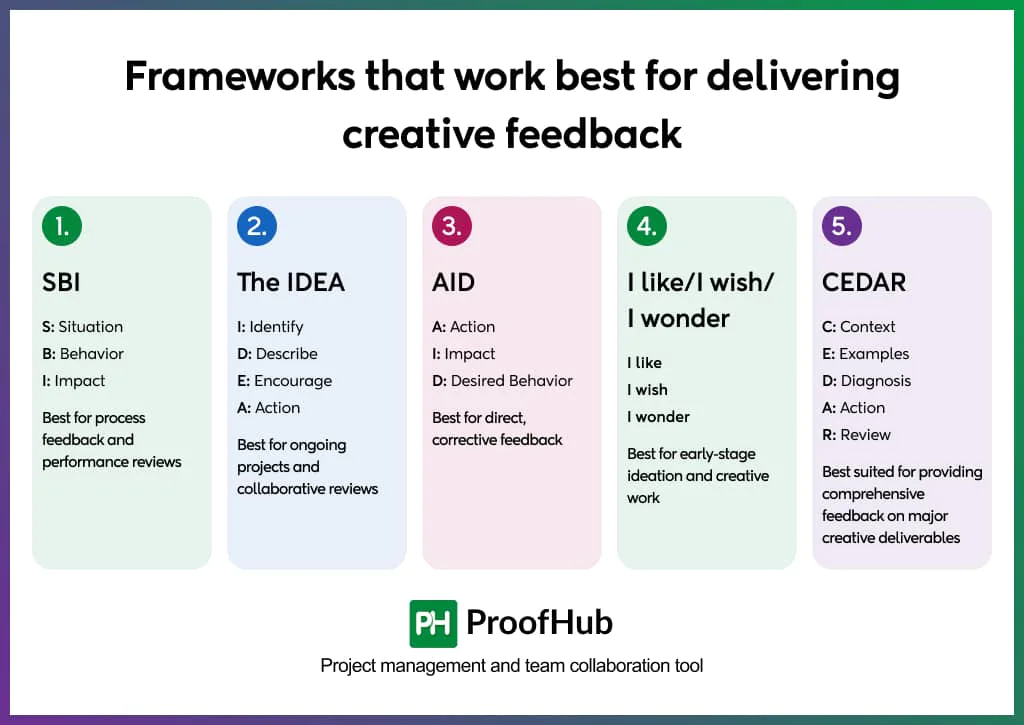
1. SBI: Best for process feedback and performance reviews
- Situation: Describe the specific context
- Behavior: Describe the observable element
- Impact: Explain the effect or consequence on user understanding or performance
2. The IDEA: Best for ongoing projects and collaborative reviews
- Identify: Name the specific issue or opportunity
- Describe: Observed outcome or issue
- Encourage: Acknowledge strengths or effort while providing improvement direction
- Action: Suggest clear next steps
3. AID: Best for direct, corrective feedback
- Action: What exists in the creative
- Impact: The result or consequence
- Desired Behavior: Expected improvement
4. I like/I wish/I wonder: Best for early-stage ideation and creative work
- I like: What’s genuinely working
- I wish: What could be improved (without prescribing how)
- I wonder: Open questions that spark new thinking
5. CEDAR: Best suited for providing comprehensive feedback on major creative deliverables
- Context: Define scope
- Examples: Provide specific creative elements
- Diagnosis: Explain what’s working/not working and why
- Action: Recommend concrete steps
- Review: Confirm effectiveness after revision
Additional frameworks worth knowing:
- COIN (Context, Observation, Impact, Next Steps)
Similar to SBI but adds the “Next Steps” element.
- RADAR (Repeat, Ask, Discuss, Align, Reflect)
Works well for complex creative projects requiring deep dialogue.
- The feedback sandwich: Positive → Constructive → Positive
Only works best when positive feedback is genuine and specific.