Projects fail when the plan outlives the facts. In PMI’s 2017 Pulse of the Profession, 69% of projects met their original goals, which means nearly one in three did not.
Requirements change mid-build, customers reject finished work, and teams discover mistakes only at final delivery. Fixed plans respond to these shocks slowly and at high cost. Agile and adaptive frameworks absorb them in small, inexpensive steps.
These frameworks split work into short cycles, collect feedback after each one, and adjust the plan before small errors become expensive. Agile is the most common adaptive approach. Scrum and extreme programming add defined roles and rules, while kanban uses a visual flow system.
The guide explains what agile and adaptive frameworks are, how they work, and when each one fits. It also covers common adoption challenges, project types where agile fails, and the metrics that track progress.
- 1.Agile works in short cycles and uses feedback to adjust the plan before problems grow.
- 2.Agile is one way to apply the broader adaptive mindset.
- 3.Match the framework to the work: Scrum for products, Kanban for support, SAFe for scale.
- 4.Use agile when requirements change and customers stay involved; choose predictive or hybrid when scope, documentation, or sequence is fixed.
- 5.Start with one pilot team, track two metrics such as cycle time and customer satisfaction, and expand only once the data shows a gain.
What are adaptive frameworks in project management?
An adaptive framework is an approach that replaces rigid upfront planning with continuous adjustment.
Adaptive teams expect scope, priorities, and even the end product to change. Adaptive lifecycles suit projects with high uncertainty, where teams test assumptions, learn from results, and adjust course.
Adaptive frameworks respond to uncertainty through four mechanisms:
- Short cycles or continuous flow: Teams deliver work in cycles of one to four weeks or in a steady flow of small items.
- Feedback: Stakeholders and users review working output at the end of each cycle.
- Reprioritization: Teams reorder the backlog after each review, so the most valuable work comes first.
- Incremental delivery: Teams release usable pieces of the product instead of one final deliverable.
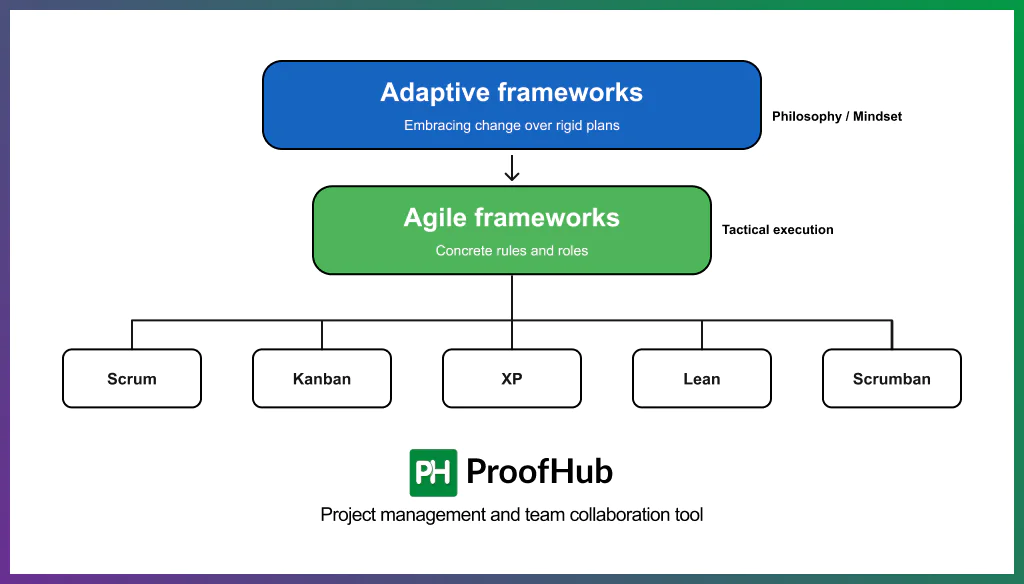
To understand modern project management, you must first clear up a common misconception: “Agile” and “Adaptive” are not two competing frameworks.
Instead, they share an umbrella relationship.
What is Agile project management?
Agile project management is an iterative approach that delivers value frequently and adapts to feedback. Teams split the work into small increments, build the highest-value one first, and release it to users. Stakeholder reactions to that release shape the plan for the next cycle.
Customers or their representatives join planning, reviews, and testing, so their input shapes the backlog throughout the project. Teams add new requirements to the backlog at any time and rank them by value.
Agile is an iterative approach, not a single framework. Scrum and extreme programming (XP) turn those values into specific roles, events, and rules or, in Kanban’s case, a visual flow system.
Popular agile and adaptive frameworks
All six frameworks below are Agile frameworks, and every Agile framework is adaptive. Adaptive is the broader category, and Agile frameworks apply it through specific roles and rules.
Frameworks differ in workflow, roles, planning cadence, and delivery model. The table compares six of them.
1. Scrum
Scrum organizes work into fixed-length sprints of one to four weeks. The scrum guide defines three accountabilities: Product Owner, Scrum Master, and Developers. Each sprint includes sprint planning, a daily scrum, a sprint review, and a retrospective. Every sprint produces a usable version of the product.
2. Kanban
Kanban manages work as a continuous flow on a visual board. Columns such as To Do, In Progress, and Done show each task’s status. Cards piling up in one column reveal bottlenecks that slow delivery. Team members pull new work when capacity opens.
3. Extreme programming (XP)
Extreme programming (XP) is an Agile framework that improves software quality through engineering practices. Core practices include pair programming, test-driven development, continuous integration, and small frequent releases. XP teams usually work in one-to-two-week iterations with close customer involvement.
4. Lean project management
Lean project management is a framework that delivers customer value while cutting waste. Teams follow five principles. They identify what customers value, map the steps that deliver it, and keep work moving without delays. Teams start new work only when customers need it, then keep improving the process.
5. Scrumban
Scrumban blends scrum’s structure with kanban’s flexibility. Teams use a visual board and cap the work in progress, and they plan new work only when the backlog runs low, not at the start of each sprint. It suits teams that want to move from sprints to continuous flow.
6. Scaled Agile frameworks
Scaled agile frameworks help many agile teams work together on the same product. When a company has dozens or hundreds of people building one thing, a single team’s methods aren’t enough. They give teams a shared planning cadence, shared backlogs, and shared roles. Popular ones include SAFe (Scaled Agile Framework), LeSS (Large-Scale Scrum), Nexus, and Scrum@Scale.
Take SAFe as an example. It organizes work into blocks of 8 to 12 weeks, called program increments (PIs). At the start of each block, all the teams meet to plan together, so everyone knows what they’re building and how their work fits with the others.
How Agile and adaptive frameworks work?
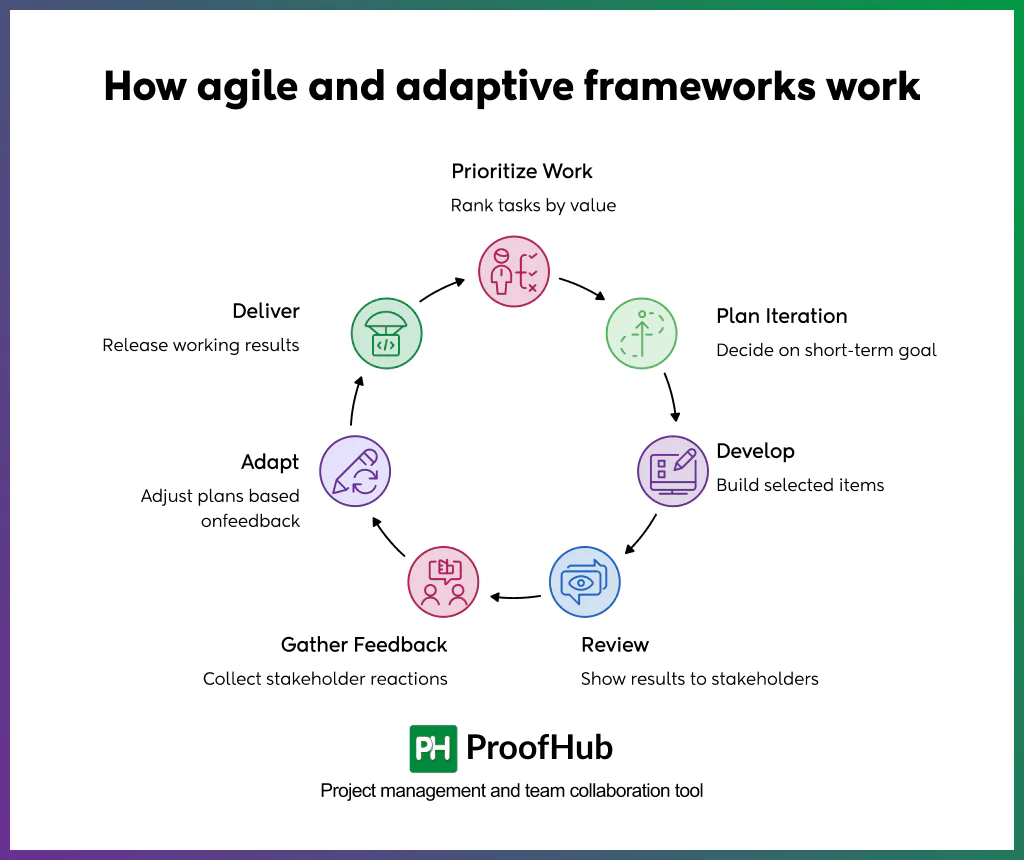
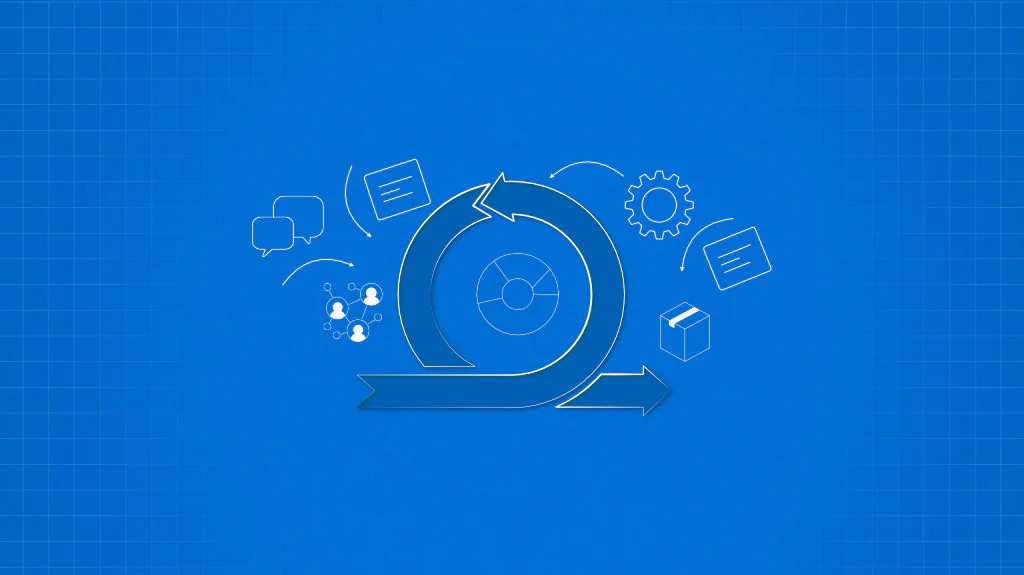
Agile and adaptive frameworks work in a repeating loop, not a straight line. In a traditional approach, a team plans everything upfront, builds for months, and delivers at the end. If something is misunderstood, it is discovered too late. Agile frameworks avoid this by working in small steps, checking the result after each one, and using what they learn to decide what to do next.
The loop has seven stages.
1. Prioritize work
Every team has more ideas, requests, and tasks than it can finish. The first step is to collect them all in one list, called the backlog, and rank them by value. Value can mean different things: money earned, problem solved for customers, risk reduced, or a deadline that cannot be missed.
The most important items go to the top, and the least important sit at the bottom or are removed. The team doesn’t rank the backlog just once. The team revisits it regularly, because what mattered last month may not matter today.
2. Plan iteration or flow
Once the work is ranked, the team decides how much to take on, and this method depends on the framework.
In scrum, the team plans an iteration, a short, fixed period of usually one to four weeks called a sprint. The team picks the top items from the backlog that it can realistically finish in that time.
In kanban, there are no fixed iterations. Work moves across a visual board, and the team pulls the next highest-priority item from the backlog whenever it has capacity. This steady movement of work is called continuous flow.
In both cases, the plan stays small and short-term on purpose, even if the project runs for a year. The team commits only to the next small batch of work and plans the rest as it learns more.
3. Develop
After planning the iteration, the team now builds the selected items. The team breaks the work into small pieces so that something usable exists early.
Team members talk daily, often in a short meeting where each person shares what they finished, what they are working on, and what is blocking them.
Teams surface problems early and fix them within days. Quality checks, such as testing, happen during this stage too.
4. Review
When the planned work is finished, the team shows it to the stakeholders. Stakeholders are the people who have an interest in the product, such as customers, managers, or other departments.
The review is a live demonstration of working results. Seeing the real thing makes it much easier for people to react. Something that sounded fine in a document may feel wrong the moment someone uses it.
5. Gather feedback
During and after the review, the team collects reactions from stakeholders and real users. Useful questions include:
- What works well?
- What is confusing or frustrating?
- What is missing?
- Did this solve the problem it was meant to solve?
Feedback can come from conversations, surveys, usage data, or support requests. The team also looks inward at how it worked together, often in a meeting called a retrospective, where members discuss what went well, what did not, and what to change.
What matters most is what happens to the feedback afterward. In a predictive approach, changes usually go through a formal change-approval process, so feedback may wait for sign-off before it affects the plan. In an Agile approach, feedback goes straight into the backlog and changes what the team builds next.
For example, a team runs a weekly newsletter. Readers say the emails are too long, and many stop reading halfway. The team adds “shorten the newsletter” to the top of its backlog and tests shorter emails in the next issue. The feedback did not end up in a report. It changed what the team worked on next.
6. Adapt
Adapt is the step that makes the whole loop worthwhile. The team looks at everything it has learned and changes its plans accordingly.
It may reorder the backlog, add new items, drop items that no longer matter, or change how the team works. Adapting means the next cycle will be different from the last one because of what was learned.
7. Deliver
The team releases working results to users so they can start benefiting from them. Delivery happens often, in small amounts, not once at the end of a long project.
This keeps risk low, because a small mistake is cheap to fix, and it gives the team real-world feedback to feed into the next round. Then the loop starts again at step one.
Agile vs predictive project management
Agile plans a little at a time and changes course based on feedback. Predictive project management locks the plan in at the start and follows it to the end. This is the core difference between Agile and predictive project management. If you can define the full scope before work starts, choose predictive. If you will only learn what is needed by building and getting feedback, choose Agile.
When to use Agile and adaptive frameworks
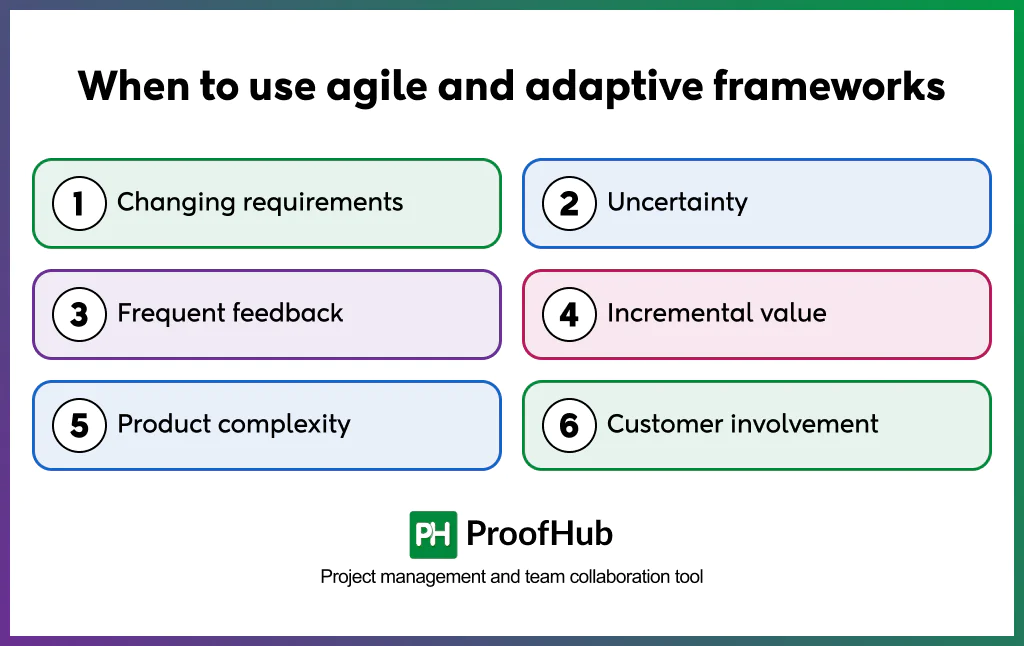
Agile and adaptive frameworks fit projects with changing requirements, uncertainty, frequent feedback, incremental value, product complexity, and customer involvement. Each factor describes a situation where building in short cycles works better than planning everything upfront.
Use agile and adaptive frameworks when:
1. Requirements change frequently
Agile fits when stakeholders keep changing what they want while the project is still underway, or when you expect them to. For example, a client might ask for a new type of report after seeing each progress demo.
The team adds each request to a prioritized to-do list called the backlog and builds it in the next work cycle, which usually lasts one to four weeks. Each change becomes a routine backlog update that the team absorbs within days, so the plan never has to be renegotiated.
2. There are uncertainties in project
Some projects begin with questions nobody can answer initially. Will users want the product? Will the technology work? A company launching an app in a new market cannot know which features people will pay for.
A fixed plan forces the team to guess and spend the full budget before learning anything. Agile tests the unknowns first. The team builds a small working version, lets a few real users try it, and measures their behavior.
The results show whether to continue, change direction, or stop while mistakes still cost little.
3. Feedback is frequently exchanged
Projects benefit from short cycles when the team and its users or stakeholders can discuss the work every one to four weeks. In a weekly demo, for example, the sales team sees the latest version and points out that a report is missing.
A plan fixed at the start collects feedback late, so the team builds on guesses and finds mistakes only after they have spread through the work.
Agile builds the exchange into every work cycle: the team shows what it built, stakeholders respond, and the team applies the changes, such as adding the report or speeding up a slow page, in the next cycle. Mistakes get fixed while they are still small.
4. Value is incremental
A project delivers incremental value when parts of the product are useful before the whole is finished. An online store, for example, can start taking orders while the delivery-tracking feature is still being built.
A plan fixed at the start releases everything at the end, so customers wait months and the business sees no return until then. Agile releases the highest-impact features first, so users benefit and the business earns while the rest is built.
5. Product is complex
Products with many connected parts are hard to plan on paper, because nobody can predict how the parts will behave together. A customer portal, for example, has to work with the billing system, the customer database, and the login service.
A plan fixed at the start assumes the parts will fit, and the conflicts show up only when everything is joined near the end, when fixing them means rebuilding finished work.
Agile joins and tests the connected parts in every work cycle. Conflicts surface within weeks, while the affected work is still small and cheap to fix.
6. Customers are involved
Agile works best when customer feedback shapes what the team builds next. In a fixed plan, teams gather requirements upfront and spend months building based on their initial understanding.
Customers see the product only at delivery, when gaps or unmet needs often surface. By then, changing direction is slow and expensive.
Agile breaks work into short cycles, each ending with a working version customers can try. Their feedback shapes the next cycle, helping teams refine existing features, address gaps, and focus on what matters most to customers.
Common challenges when adopting Agile and adaptive frameworks
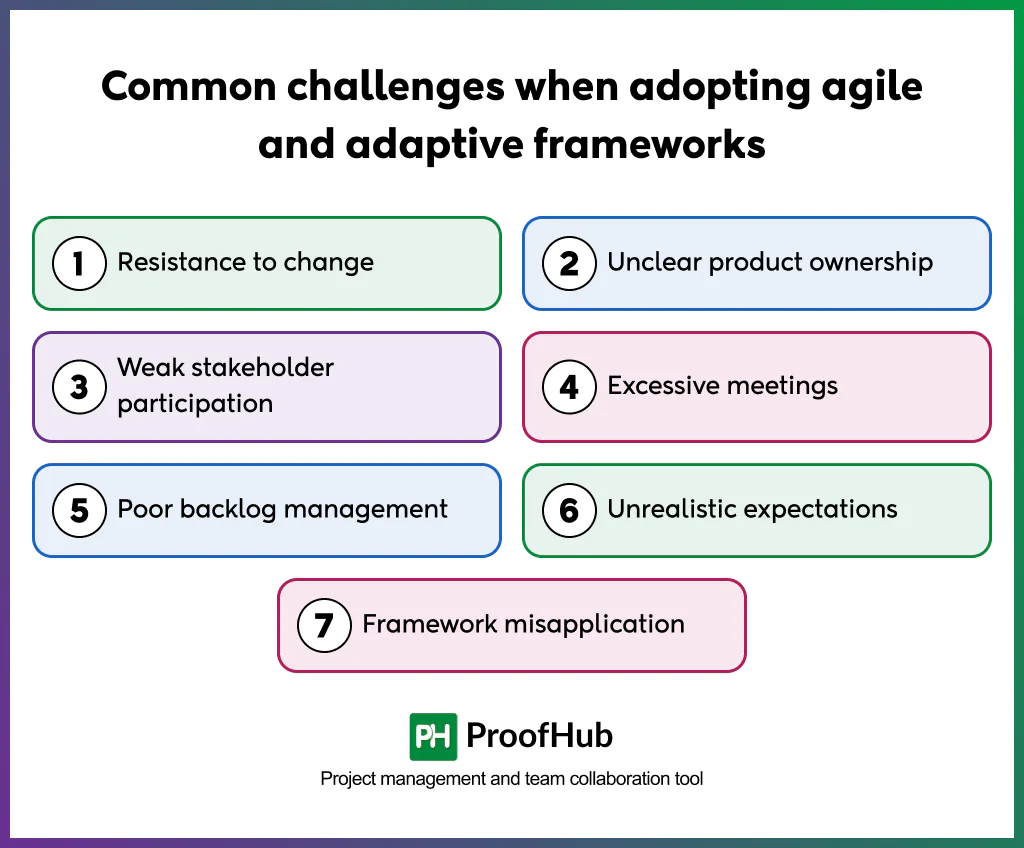
Resistance to change, unclear product ownership, weak stakeholder participation, excessive meetings, poor backlog management, unrealistic expectations, and framework misapplication are the seven common challenges teams face when adopting Agile and adaptive frameworks.
Each challenge below describes the problem and ends with a specific fix.
- Resistance to change: Staff push back when new routines replace familiar workflows and established roles. Managers fear losing control, while team members doubt that short cycles improve results. Adoption slows, and staff split into supporters and opponents of the new approach.
- Unclear product ownership: No single person controls the whole backlog. Stakeholders submit conflicting priorities, and the team works on whatever sounds most urgent that week. Teams stall, delivery drifts away from business goals, and valuable capacity is wasted.
- Weak stakeholder participation: Stakeholders skip reviews and planning sessions. Teams lose their feedback loop and have to guess requirements, which causes rework after delivery. Products miss real user needs and ship features nobody wants.
- Excessive meetings: Meetings multiply when teams add status updates, extra syncs, and unfocused discussions. Every session consumes hours that the team needs for creating and testing deliverables. As a result, output drops, and frustration rises.
- Poor backlog management: Backlog items stay vague or unranked for several weeks. The team cannot estimate unclear work, so planning slows and priorities drift. Stakeholders lose trust in the roadmap and stop contributing ideas.
- Unrealistic expectations: Leaders expect immediate speed gains from Agile and still demand fixed scope, cost, and dates. Early cycles run slower while teams learn new habits. Disappointment triggers pressure and pushes the group toward old practices.
- Framework misapplication: Teams copy routines without understanding their purpose. Some groups hold daily status meetings yet never reorder priorities or release working output. These routines take up time but bring no real benefit.
When Agile may not fit a project?
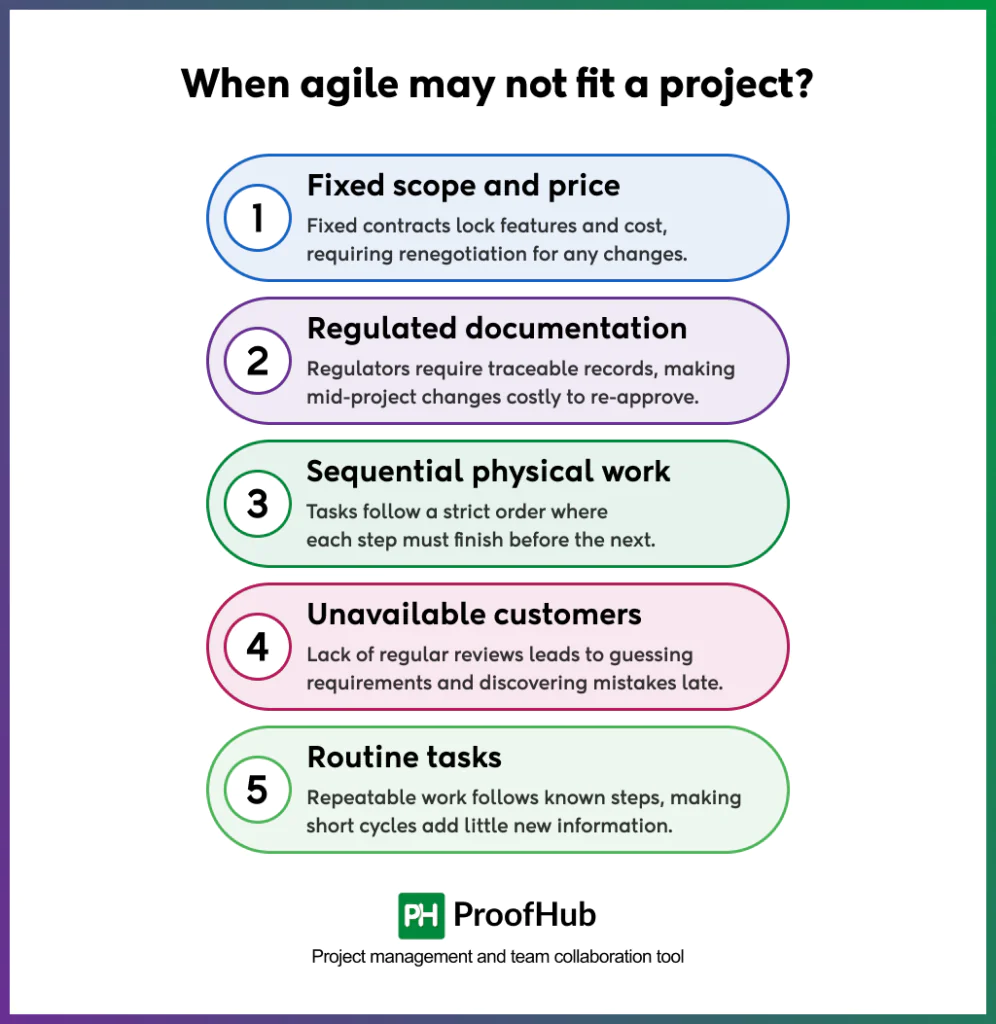
Agile does not fit projects with fixed scope and price, regulated documentation, sequential physical work, unavailable customers, or routine tasks. Each condition below ends with an alternative.
1. Fixed scope and price: Fixed contracts lock the features and the cost before work starts. Any change forces both sides to renegotiate. To handle this, use a predictive plan or negotiate a flexible contract with a capped budget.
2. Regulated documentation: Medical device and aerospace regulators require documented, traceable requirements and design records. Changing requirements midway forces costly re-approval and re-documentation. To handle this, follow a sequential plan or iterate only inside approved specifications.
3. Sequential physical work: Construction follows one order: foundation, framing, then wiring. Crews cannot reorder these steps, and each step must finish before the next begins. To handle this, use a phased plan or apply short cycles only to design work.
4. Unavailable customers: Short cycles need regular customer reviews to set the next steps. Without reviewers, teams guess what customers want and find mistakes after delivery. To handle this, secure a customer representative first or choose a predictive approach.
5. Routine, well-understood tasks: Repeatable work follows known steps that rarely change. Installing standard equipment uses the same procedure every time, so short cycles add little new information. To handle this, use a fixed checklist instead.
When should a project use an Agile framework?
Use an Agile framework when requirements will change, the solution holds unknowns, and customers review work every few weeks.
Software development, new product design, marketing campaigns, and prototyping match these conditions. Scrum fits product teams with stable membership, Kanban handles continuous support requests, and SAFe coordinates many teams.
Can Agile and waterfall be used together?
Yes, teams combine agile and waterfall in a hybrid approach that applies each method where it performs best. Three patterns dominate:
- Planned start, Agile build: Teams fix budget and compliance requirements first, then build in short cycles.
- Agile build, planned launch: Short cycles produce the product, and a fixed plan governs deployment and training.
- Split by workstream: Hardware follows sequential phases while software teams iterate in parallel.
Hybrid projects need one shared roadmap and one reporting format, so stakeholders track progress across both methods.
What are the main Agile metrics?
The main Agile metrics measure speed, predictability, and quality. Scrum teams track work per sprint, while Kanban teams track how fast single items move. Seven metrics cover the essentials:
- Velocity: The amount of work a team completes per sprint, used for forecasting.
- Sprint burndown: A chart of remaining sprint work against days left.
- Release burnup: A chart of completed work against total scope, which exposes scope changes.
- Cycle time: Days between starting an item and finishing it.
- Lead time: Days between a customer request and its delivery.
- Throughput: Number of items finished per week or cycle.
- Customer satisfaction: Survey scores collected after each release.
Is Agile suitable for every project?
No, Agile does not suit every project. Agile works when requirements change, and customers give regular feedback. Projects with fixed scope, strict documentation rules, or step-by-step physical work run better under predictive management. Hybrid models cover mixed cases.
Conclusion
Agile and adaptive frameworks replace fixed plans with short cycles, regular feedback, and steady adjustment. Scrum, Kanban, XP, Lean, Scrumban, and scaled frameworks apply this logic through different roles and workflows. Choose these frameworks when requirements change, uncertainty runs high, and customers stay involved. Choose predictive or hybrid approaches when scope, documentation, or physical sequence stays fixed.
To begin, start with one pilot team and choose the framework from the comparison table that matches its work, such as Scrum for product development or Kanban for support requests. Set two metrics, such as cycle time and customer satisfaction, and measure the pilot against them. Expand once the data shows a gain. If the results fall short, review the retrospective notes, adjust the approach, and rerun the pilot before scaling. Teams that learn from every cycle catch problems while they are still small and cheap to fix, which a fixed plan cannot offer.